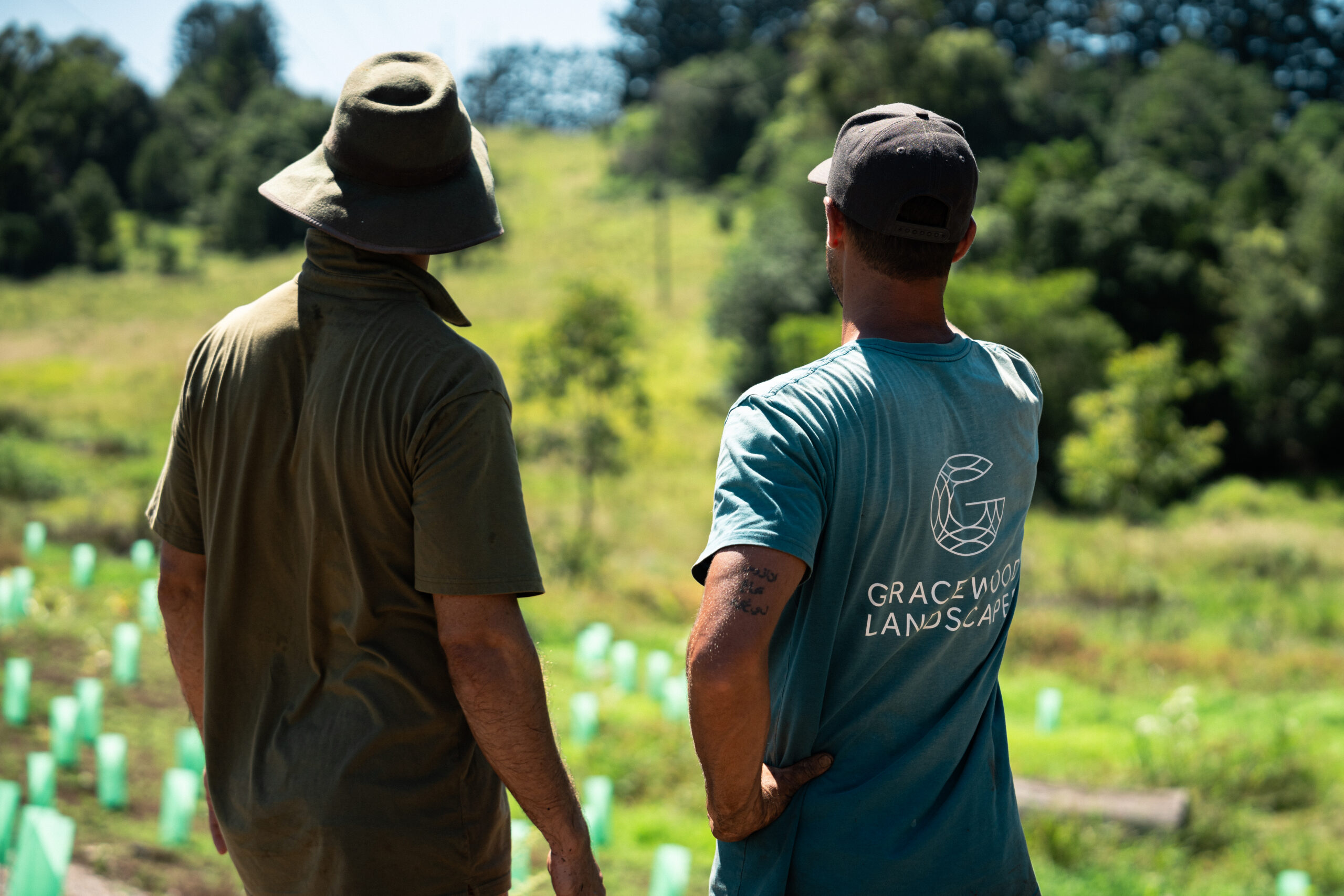
Across the Northern Rivers, a quiet but significant shift is underway. Thousands of hectares of macadamia orchards — once the backbone of the region’s agricultural economy — are being retired as farmers age, markets shift, and the economics of small-scale macadamia farming become increasingly difficult to justify. For many landowners, this creates both a challenge and an extraordinary opportunity. Macadamia farm revegetation in the Northern Rivers is becoming one of the most meaningful — and valuable — land use transitions happening in this region right now, and Gracewood Landscapes is at the forefront of making it happen.
Why So Many Macadamia Farms Are Being Retired
At its peak, the Northern Rivers was one of Australia’s premier macadamia growing regions. The combination of subtropical climate, reliable rainfall, and fertile volcanic soils made it ideal country for the crop. But the industry has consolidated significantly over recent decades, with large corporate operations dominating production and squeezing margins for smaller growers.
Many of the family-owned orchards that were established in the 1970s and 1980s are now reaching the end of their productive life — both in terms of tree age and the age of their owners. For the next generation inheriting these properties, continuing as a working macadamia farm is often not the goal. The question becomes: what do we do with this land?
The Case for Rainforest Restoration
The Northern Rivers sits within one of the most biodiverse regions in Australia. The area’s subtropical rainforest is internationally significant — it forms part of the Gondwana Rainforests of Australia World Heritage Area — and the region’s biodiversity has been dramatically reduced through a century of agricultural clearing. Restoring native rainforest on former farmland isn’t just an environmental act; it’s a restoration of something genuinely irreplaceable.
Beyond the ecological value, there are increasingly compelling practical reasons to pursue revegetation. Carbon farming and biodiversity offset markets are growing in Australia, and well-documented revegetation projects on private land can generate real income through carbon credits and biodiversity certificates. Property values for land with established native vegetation are also rising steadily as the lifestyle and conservation property market in the Northern Rivers continues to strengthen.
What Makes Macadamia Farm Revegetation in the Northern Rivers Different
Not all revegetation projects are the same, and macadamia farm revegetation in the Northern Rivers presents a specific set of challenges and opportunities that require genuine expertise to navigate well.
Macadamia orchards leave behind a particular legacy in the landscape. The trees themselves — which are actually native to Queensland and northern NSW — need to be assessed on a case-by-case basis. Some landowners want them removed entirely; others choose to retain selected specimens as canopy trees within the new planting scheme, which can actually accelerate the establishment of understorey species by providing immediate shade and habitat.
The soil under a macadamia orchard has typically been managed intensively — mown, fertilised, and in some cases treated with herbicides. Understanding the soil biology and preparing it properly before planting is critical to the long-term success of the revegetation. This is where having a team with genuine horticulture qualifications makes a real difference.
Weed management is the other major challenge. Macadamia orchards are rarely weed-free, and the ground layer is often dominated by exotic pasture grasses and environmental weeds that will aggressively compete with newly planted native seedlings. A proper revegetation plan includes a strategic weed control program — typically beginning 6 to 12 months before planting — to give the new plants the best possible start.
The Gracewood Approach: Landscaping Expertise Meets Ecological Knowledge
What distinguishes macadamia farm revegetation with Gracewood Landscapes from a standard planting project is the integration of landscaping design thinking with ecological restoration practice. Our team holds qualifications in horticulture, arboriculture, structural landscaping, and land management — which means we bring a much richer toolkit to revegetation projects than a standard planting crew.
We think carefully about species selection — not just in terms of what’s ecologically appropriate, but how the planting will develop over time as a landscape. We consider sight lines, the creation of habitat features like rock piles and log placements, the integration of any existing vegetation or landscape features, and how the property will look and function for the landowner over a 5, 10, and 20-year horizon.
We also bring the machinery and earthworks capability to prepare sites properly — ripping compacted soils, reshaping landforms if required, and installing any necessary drainage before planting begins. This integrated approach is what separates a revegetation project that truly thrives from one that struggles through years of establishment.
Species Selection for Northern Rivers Rainforest Restoration
The Northern Rivers supports an extraordinary range of subtropical and warm temperate rainforest species, and species selection for any given site depends on factors including elevation, aspect, rainfall, soil type, and proximity to existing remnant vegetation.
A typical planting scheme for macadamia farm revegetation in the Northern Rivers might include pioneer species like Bleeding Heart (Omalanthus populifolius), Macaranga tanarius, and various Acacia species to provide rapid canopy cover and nurse conditions for the longer-lived rainforest species. Mid-storey species like Blueberry Ash (Elaeocarpus reticulatus), Tuckeroo (Cupaniopsis anacardioides), and various fig species follow, with understorey planting of ferns, gingers, and ground covers filling in the lower layers over time.
Getting this mix right — and sourcing plants from local provenance seed stock where possible — is one of the most important factors in establishing a genuinely resilient and self-sustaining rainforest ecosystem. Gracewood Landscapes works with trusted local nurseries and, where projects warrant it, can develop site-specific planting lists with ecological input.
What Does a Typical Project Look Like?
Every macadamia farm revegetation project in the Northern Rivers is different, but a typical Gracewood project follows a clear process: initial site assessment and goal-setting with the landowner; development of a planting plan and weed management strategy; site preparation including any earthworks and soil conditioning; staged planting across the cooler months; and follow-up maintenance including watering support during the first dry season and ongoing weed management through the critical first two years of establishment.
Some projects also integrate fencing to protect plantings from grazing pressure, simple path networks to allow the landowner to move through and enjoy their emerging forest, and creek or gully restoration where waterways run through the property.
Is This Right for Your Property?
If you own former macadamia farmland — or any degraded, cleared, or underutilised land — in the Northern Rivers and you’re ready to explore what revegetation could look like, Gracewood Landscapes would love to have a conversation. We work with landowners at all stages of the process, from the earliest thinking through to full project delivery and ongoing care.
This is one of the most rewarding work we do — and one of the most lasting legacies a landowner can leave on the Northern Rivers landscape. Get in touch to arrange a site visit and let’s talk about what your land could become.